Healthy Minds Compact Building
Building develops children’s growing ability to notice what is happening inside themselves, understand other people’s perspectives and recognise connections between thoughts, feelings and actions.
Children move beyond simply recognising skills and begin to understand, practise and choose between different ways of responding.
The seven core lessons are: 1. Kindness in Action Understanding kindness as something we can notice, choose and practise. 2. Name That Feeling Developing emotional vocabulary and recognising emotions as useful signals. 3. Active Listening Learning to listen to understand rather than simply waiting for a turn to speak. 4. Choosing What We Notice Learning to widen attention when thinking becomes stuck mainly on difficulty or what might go wrong. 5. Choosing Helpful Stories Beginning to separate what happened from the interpretation the brain adds and considering what else could be true. 6. Me at My Best Recognising strengths through evidence and understanding that strengths can be practised and developed. 7. My Happy Helps *Understanding positive emotion as one useful psychological fitness resource rather than something we should feel all the time.
Building also includes a: Regulation Skills Toolkit
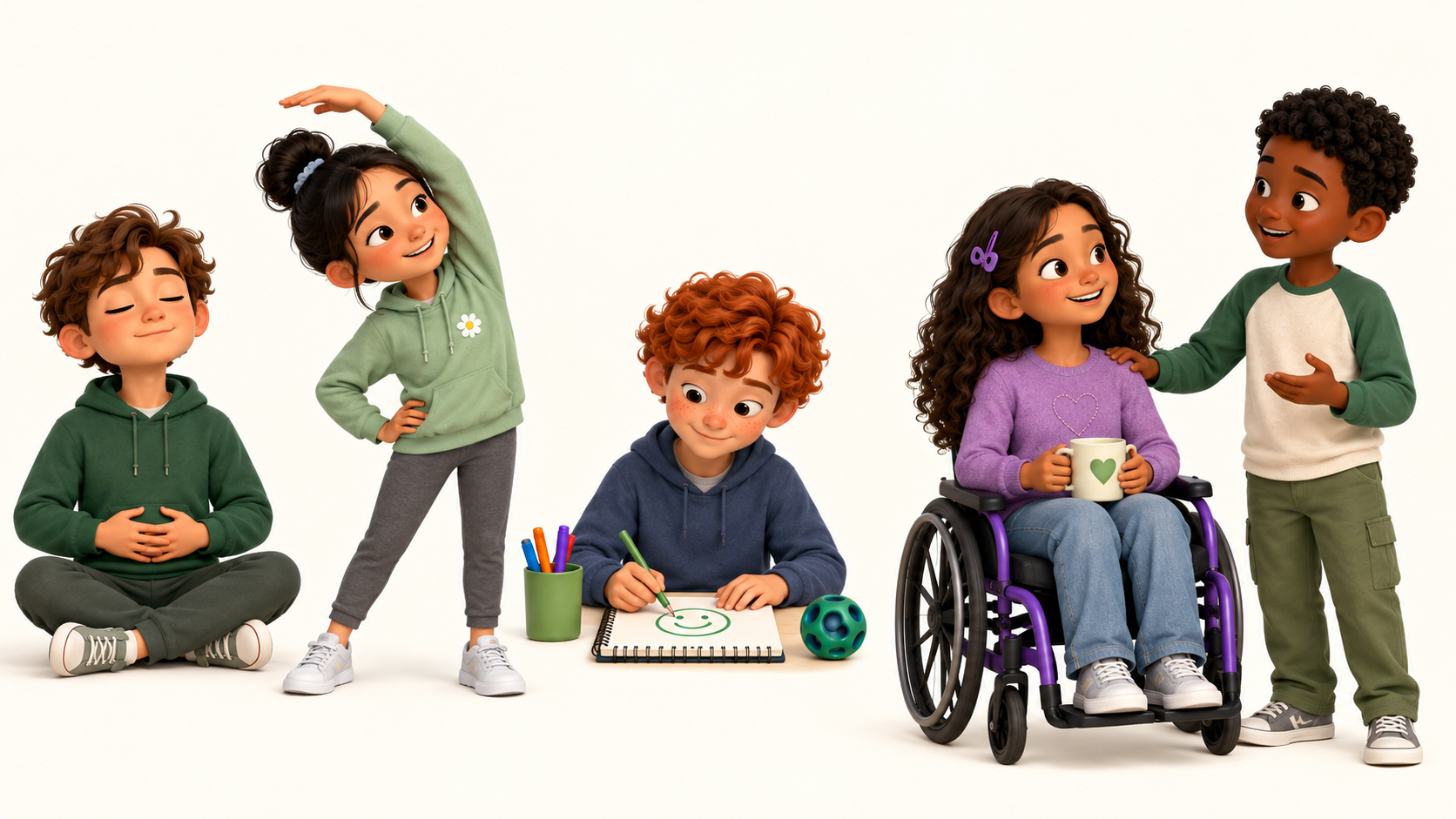
Children practise a growing range of regulation strategies, including: • body skills • breathing and intentional stillness • distraction skills • connection skills • talking and spending time with other people • gratitude.
Children learn: Notice what is happening → Choose a strategy → Try it → Notice what happens
The emphasis is not on finding one technique that always works. It is on building a bank of possibilities and learning to choose thoughtfully.
Developmental focus Notice it → Understand it → Practise it → Use it Children develop greater awareness, flexibility and choice.
This resource is supported by a **recorded CPD **series giving teaching professionals the core psychological ideas, developmental approach and practical teaching principles behind Healthy Minds Compact from Nursery to Year 6.
Lessons
8 lessons in this module.
Healthy Minds Compact: Building: Kindness in Action
Children explore kindness as something we do, rather than simply something we are.
Healthy Minds Compact: Building - Name That Feeling
Children build emotional vocabulary and learn to recognise emotions as useful signals. Children are not taught that particular body signals always mean one emotion, or that there is one correct strategy for a particular feeling. They learn to notice, stay curious and build a range of possibilities.
Healthy Minds Compact: Building - Active Listening
Children explore listening as an active relationship skill rather than simply remaining quiet while someone else speaks. The emphasis is on attention rather than compulsory eye contact. Children can show listening in different ways. Core idea: Listen to understand, not simply to wait for your turn to speak.
Healthy Minds Compact: Building - Choosing What We Notice
Children are introduced to optimistic and pessimistic thinking as different ways attention can be directed. Optimistic thinking is not presented as ignoring difficulty or pretending everything will be fine. Children first acknowledge what is hard and then practise looking more widely. They use four practical questions: What is hard here? What else is also true? What can I control? What could I try next? Core idea: We can practise widening our attention when our thinking becomes stuck.
Healthy Minds Compact: Building - Choosing Helpful Stories
Children begin to explore the relationship between an event and the interpretation their brain makes of it. Children are not being taught to replace uncomfortable thoughts with positive ones. They are learning to become more flexible thinkers. A simple structure supports the learning: What happened? → What is my brain telling me? → What else could be true? → What could I do next? Core idea: The first story our brain tells us is not always the only possible story.
Healthy Minds Compact: Building - Me at My Best
Children explore strengths as qualities that become visible through actions. Instead of teaching children that they are “the brave one”, “the kind one” or “the clever one”, adults help them notice evidence: “You showed bravery when you shared your idea even though you felt unsure.” Core idea:Strengths are things we can notice, use, practise and grow.
Healthy Minds Compact: Building - My Happy Helps
Children explore healthy positive emotion as one useful part of psychological fitness. The aim is not to remove difficult feelings. Children learn that small, healthy experiences of enjoyment, connection, movement or play can sometimes help them meet difficulty with a more ready mind and body. Core idea: Happiness can be a tool — not a rule.
Healthy Minds Compact: Building - Regulation Skills Toolkit
The Regulation Skills Toolkit sits alongside the seven lessons. It gives children opportunities to practise simple regulation techniques before they urgently need them. The central message is: Notice what is happening → Choose a strategy → Try it → Notice what happens Children learn that different situations may need different approaches and that there is no single technique that works for everyone, every time. The toolkit introduces three broad types of strategy. Body skills Distraction skills. Connection skills. The goal is not to teach children one “correct” way to regulate. It is to help them develop a growing bank of choices and the ability to use those choices thoughtfully.